Curtis.Castiglione@ROzebra.com
What Is an Automotive Alignment Rack?
What Is an Automotive Alignment Rack?
If you have ever noticed your steering wheel sitting crooked while you are driving straight down the highway, or if your car seems to want to drift into the next lane the moment you let go of the wheel, you have likely heard a mechanic mention the need for an alignment. To perform this service accurately, a shop uses a specialized piece of professional automotive equipment known as an automotive alignment rack.
While it might look like a standard vehicle lift at first glance, an automotive alignment rack is a precision-tuned platform designed to provide a perfectly level surface for measuring and adjusting a vehicle's suspension geometry. Without this specific tool, it would be nearly impossible to ensure that all four wheels are pointing in exactly the right direction.

What Is an Automotive Alignment Rack?
An automotive alignment rack is a heavy-duty platform that supports the entire weight of a car or truck while allowing the wheels to move freely for adjustment. It serves as a high-tech stage where a vehicle sits so that sensitive sensors and cameras can calculate the exact angles of the wheels.
The most important characteristic of an alignment rack is that it must be perfectly level. In a standard repair shop, the concrete floor often has a slight slope for drainage or minor imperfections. If you tried to align a car on an uneven floor, the measurements would be wrong before the technician even started. The alignment rack is bolted to the garage floor and calibrated so that the runways—the tracks the tires sit on—are flat to within a fraction of a millimeter.
What Does an Alignment Rack Do?
The primary job of the rack is to provide a stable, controlled environment for measuring the three main alignment angles. This is more than just a standard car tool; it is a car diagnostic tool that interprets how your car’s suspension is interacting with the road. The three primary measurements are:
- Camber: This is the inward or outward tilt of the tire when viewed from the front. If the top of the tire leans toward the engine, that is negative camber. If it leans away from the car, it is positive camber. Improper camber leads to one side of the tire wearing out much faster than the other.
- Caster: This is the angle of the steering axis when viewed from the side. Think of the front forks on a bicycle; they are angled to help the bike travel in a straight line and help the steering wheel return to the center after a turn.
- Toe: This refers to the direction the tires are pointing relative to each other, similar to being pigeon-toed or duck-footed. If the front of the tires are closer together than the rear, that is "toe-in." Incorrect toe is the leading cause of rapid tire wear.
The alignment rack allows a technician to see these measurements in real-time on a computer screen. As the technician turns a bolt on a control arm or adjusts a tie rod, the rack stays perfectly still while the computer updates the angles instantly.
How Is an Automotive Alignment Rack Used?
The process begins by driving the vehicle onto the long runways of the rack. Once the car is positioned, the technician places wheel chocks to prevent it from rolling.
One of the most important steps involves using "turn plates" and "slip plates." These are mechanical plates built into the surface of the automotive alignment rack.
- Turn Plates: Located under the front wheels, these allow the tires to rotate left and right without friction.
- Slip Plates: Located under the rear wheels, these allow the tires to move slightly side-to-side.
This movement is necessary because as you adjust the suspension, the tires need to be able to move freely to settle into their natural positions. If the tires were "scrubbed" against a solid, stationary floor, the tension in the rubber would throw off the measurements, leading to an inaccurate alignment.
Next, the technician attaches targets or sensors to each wheel. These sensors communicate with a set of cameras or a central console. The technician then performs a "rolling compensation," where the vehicle is moved slightly forward and backward on the rack. This tells the computer if a wheel is slightly bent or if the sensor isn't perfectly centered, allowing the system to compensate for those errors automatically.
When Would You Need an Alignment Rack?
You typically need a vehicle placed on an automotive alignment rack in several specific scenarios:
- New Tires: To protect your investment in a new set of tires, an alignment ensures they wear evenly and last as long as possible.
- Suspension Repairs: If you replace a tie rod, a ball joint, or a strut, the geometry of the suspension has changed. These parts are vehicle repair tools and components that require a reset on a rack to work correctly.
- Impact Events: Hitting a deep pothole or a curb can bend or shift metal components. Even a small shift can cause a car to pull or vibrate.
- Handling Issues: If the car feels "darty" (reacts too quickly to steering) or feels heavy and sluggish, the alignment may be out of specification.
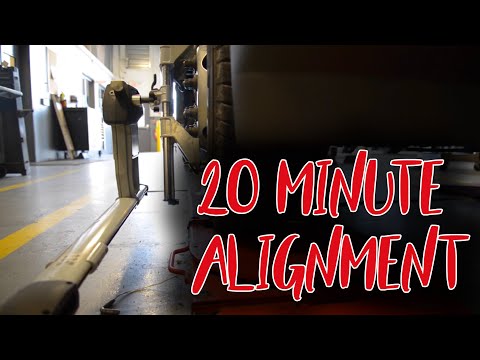
Practical Example: Consider a Ford F-150 owner who installs a leveling kit to raise the front of the truck. This modification changes the angle of the control arms. Consequently, the tires will likely point inward (toe-in) and the camber will shift. Without using an automotive alignment rack to correct this, those expensive off-road tires would likely be ruined by uneven wear within a few thousand miles.
Types of Automotive Alignment Racks
There are several variations of this professional automotive equipment found in modern shops:
- Four-Post Racks: These look like standard storage lifts with four vertical posts and two long runways. They are common because they are easy to drive onto and very stable for heavy trucks.
- Scissor Racks: These use a folding mechanism under the runways to lift the vehicle straight up. They take up less floor space than four-post racks, making them popular in smaller urban garages.
- Pit Racks: In some high-volume shops, the alignment "rack" is actually a leveled area over a recessed pit. The technician stands in the pit under the car to make adjustments while the car sits at floor level.
DIY vs. Professional Use
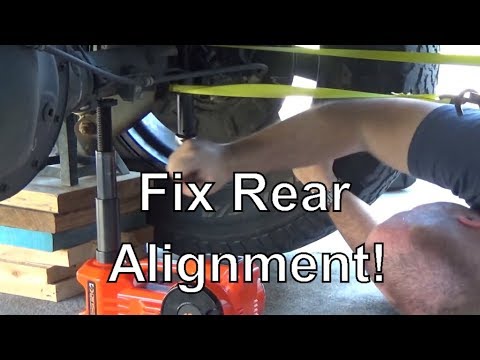
While many DIY automotive tools exist for checking alignment at home—such as string lines, toe plates, or magnetic camber gauges—a full automotive alignment rack is almost exclusively a piece of professional equipment.
The cost of a high-quality rack combined with the computerized camera system can range from $20,000 to over $50,000. Furthermore, the rack requires a significant amount of dedicated floor space and professional installation to ensure it is perfectly level. For the average enthusiast, it is more practical to perform suspension work at home using your own mechanic tools and then take the vehicle to a shop equipped with a rack for the final precision calibration.
Common Mistakes When Using an Alignment Rack
The most common mistake isn't actually with the rack itself, but failing to check the vehicle's condition before the measurement starts. If a car has a worn-out wheel bearing or a loose ball joint, the measurements on the rack will be "false." The computer might show the car is perfectly aligned, but as soon as the car moves, the loose parts shift, and the alignment is lost.
Another mistake is failing to "settle" the suspension. After a car is lifted and set back down on the rack, the springs often sit a little high. A technician must bounce the bumper or roll the car to ensure the suspension is at its natural "ride height" before locking in the final measurements.
Safety Considerations
Working around an automotive alignment rack involves heavy machinery and significant weight.
- Safety Locks: Technicians must ensure that the mechanical safety locks are engaged on the lift before stepping under the vehicle.
- Pinch Points: Because the wheels sit on turn plates and slip plates that are designed to move, it is vital to keep fingers and toes away from the gaps in the rack surface.
- Centering: Vehicles must be properly centered on the runways; a vehicle that is too far to one side can become unstable or even fall if the rack is raised to a working height.
Frequently Asked Questions
How long does a vehicle stay on the alignment rack?
A standard four-wheel alignment usually takes between 45 minutes and an hour. If the vehicle is an older model with rusted components that are difficult to turn, the process can take longer.
Is an alignment rack the same as a frame machine?
No. An alignment rack is for adjusting the bolt-on suspension components to ensure the wheels are straight. A frame machine is a different type of garage equipment used to pull and straighten the actual body or frame of a car after a major accident.
Can any car go on any alignment rack?
Most racks are universal, but very long vehicles (like extended-cab dually trucks) or very low-profile sports cars may require a rack with longer runways or specialized low-profile ramps to avoid scraping the bumpers.
Conclusion
An automotive alignment rack is a specialized tool that turns a standard garage floor into a high-precision laboratory. By providing a perfectly level surface and integrated moving plates, it allows technicians to use advanced sensors to adjust a vehicle's suspension with incredible accuracy. Whether you are a daily driver looking to save money on tires or a performance enthusiast trying to dial in your car’s handling, the alignment rack is the essential piece of automotive equipment that keeps your vehicle moving straight and true.



No Comments Yet
Be the first to comment on this article.