Curtis.Castiglione@ROzebra.com
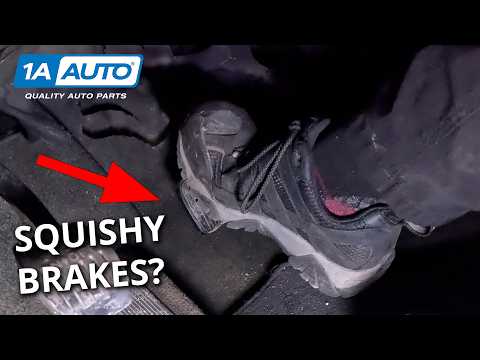
Solving the Spongy Brake Pedal: ABS Air Entrapment and Bleeding
You are pulling up to a stoplight in your truck, and as you apply pressure, you notice something unsettling. Instead of the firm, reassuring resistance you are used to, the pedal feels soft—almost springy. You might even find yourself pumping the pedal twice just to get the brakes to bite, or worse, feeling the pedal slowly sink toward the floorboard while you are waiting for the light to change.
In the shop, we call this a spongy pedal. To a driver, it feels like the connection between your foot and the road has turned into a marshmallow. To a technician, it is a clear signal that something is interfering with the physics of your hydraulic system.
The Physics of the Spongy Sensation
To understand why your brakes feel soft, we have to look at how they work. Your braking system relies on Pascal’s Law, which states that pressure applied to a confined fluid is transmitted undiminished throughout the fluid.
Brake fluid is a liquid, and liquids are incompressible. When you step on the pedal, that force is transferred directly to the brake pads. However, air is a gas, and gases are highly compressible. If even a tiny bubble of air gets trapped in your brake lines, the force from your foot goes into squishing that air bubble instead of moving the fluid. The result? A mushy pedal and a dangerous increase in your stopping distance.
Why Modern Trucks are Different
Years ago, bleeding brakes was simple: you opened a valve, pumped the pedal, and the air came out. In modern trucks equipped with Anti-lock Braking Systems (ABS) and Traction Control, the game has changed.
Your brake fluid no longer travels in a straight line from the master cylinder to the wheels. Instead, it passes through a hydraulic modulator assembly. This unit is a complex labyrinth of:
- Internal micro-passages
- Check valves
- Solenoid-operated chambers
These components are designed to pulse your brakes hundreds of times per second during an emergency. Unfortunately, they also act as perfect high-point traps for air bubbles. Once air gets stuck inside these tiny valves, a traditional manual bleed usually will not budge it.
The Two Hidden Culprits of Air Entrapment
If you have recently had brake work done and the pedal still does not feel right, the issue usually stems from one of two technical oversights:
1. Improper Master Cylinder Bench-Bleeding
The master cylinder sits at the top of the system. If a technician installs a new one without first bench-bleeding it (purging the air on a workbench before installation), air becomes trapped in the primary piston. When the lines are connected, that air is pushed deep into the ABS unit, where it becomes nearly impossible to extract.

2. The Need for a Service Bleed
This is the most common reason for a persistent spongy pedal in modern vehicles. During a standard two-person pump-and-hold bleed, the internal solenoid valves inside the ABS module remain closed. This effectively locks air inside the secondary circuits of the modulator.
To fix this, a technician must use a bi-directional scan tool. This specialized computer plugs into your truck’s diagnostic port and commands the ABS pump to run and the solenoids to cycle open and closed while the system is being bled. This sweeps the trapped air out of the ABS unit and pushes it down the lines to the wheels where it can be removed.
Actionable Advice: What to Tell Your Mechanic
A spongy pedal is not just a nuisance; it is a safety risk. Air in the lines can expand as your brakes get hot (like when driving down a long hill), which can lead to a total loss of braking power.
If your brakes do not feel rock solid, here is what you should discuss with your service provider:
- Describe the Symptom Precisely: Tell them if the pedal sinks at a stop or if it requires a double-pump to feel firm.
- Ask About the ABS Service Bleed: Specifically ask, "Do you have the scan tool necessary to cycle the ABS solenoids during the bleeding process?"
- Verify the Master Cylinder: If the master cylinder was recently replaced, ask if it was bench-bled before installation.
Your truck’s braking system is as much an electronic system as it is a mechanical one. Achieving a firm, consistent pedal requires more than just a wrench—it requires the right digital strategy to ensure every microscopic bubble is purged. Don’t settle for a marshmallow pedal; your safety depends on a solid column of fluid between your foot and the pavement.
Written by Curtis Castiglione



No Comments Yet
Be the first to comment on this article.