Curtis.Castiglione@ROzebra.com
Race Car Setup Tracking Tools
In the world of grassroots racing, the fastest driver isn't always the one with the biggest budget or the most horsepower. Usually, it is the driver who understands exactly how their car responds to changes.
If you show up to a track day, run three sessions, and "turn some knobs" on your shocks without writing anything down, you aren't tuning—you are gambling. To move from guessing to knowing, you need a system to track your progress. Here are the practical, essential tools every amateur racer needs to build a setup database that actually helps you get faster.
1. The Two-Dollar Secret: A Physical Notebook
The most important tool in your paddock is a simple, physical notebook. While many racers try to use digital spreadsheets or phone apps, a notebook has three distinct advantages for the amateur environment:
- Reliability: It never runs out of battery, has no software glitches, and does not lose signal in remote track areas.
- Usability: You can quickly scribble notes while wearing grease-stained gloves or standing in the hot sun.
- Visibility: Tablet and phone screens often wash out in direct sunlight; paper is always readable.
What to record for every single session:
- The Basics: Date, time, track location, and weather (ambient temperature and sky conditions).
- Tire Pressures: Record "Cold" pressures before you go out and "Hot" pressures the second you come off the track.
- Settings: Record your damper "clicks," sway bar positions, or wing angles.
- Alignment: Note any changes made since the last event (camber, toe, etc.).
- Subjective Feedback: Does the car understeer on entry? Does the rear feel "floaty" in high-speed sweepers? Write down how the car feels, not just what it does.
- The Clock: Your best lap time and your most consistent average time.

2. Tire Pressure Gauge and Pyrometer
Tires are your car’s only contact with the ground. If you do not manage them, nothing else you do to the suspension will matter.
The Gauge
Stop using the $5 gauge from the glovebox or the one built into your air compressor. You need a high-quality, bleeder-style pressure gauge (analog or digital). Accuracy is less important than consistency. You need to know that 32 PSI today is the exact same as 32 PSI next month so your historical data remains valid.
The Pyrometer
A tire pyrometer measures the temperature of the rubber, usually at three points across the tread. By checking the temperature at the Inside, Middle, and Outside of each tire immediately after a session, you can "read" your setup like a professional:
- Center is hotter than edges: Your tire pressure is likely too high (over-inflated).
- Edges are hotter than center: Your tire pressure is likely too low (under-inflated).
- Inside edge is significantly hotter: You may have too much negative camber for that specific track, or you are spinning the tires on corner exit.

3. Lap Timers: Beyond the Stopwatch
You cannot manage what you do not measure. A lap timer is the ultimate objective judge of whether a setup change actually worked.
- Entry Level: Smartphone apps like Harry's LapTimer or TrackAddict are excellent starting points. However, phone GPS typically only updates once per second (1Hz). For better accuracy, add an external Bluetooth GPS receiver (like an XGPS160). This increases data points to 10 or 20 per second, making your lines and speeds much more accurate.
- Dedicated Units: Devices like the AiM Solo 2 or Garmin Catalyst offer "predictive lap timing." This shows you in real-time if a change in your driving or setup is making you faster or slower at that exact moment. This instant feedback is a powerful coaching tool.
4. Onboard Video
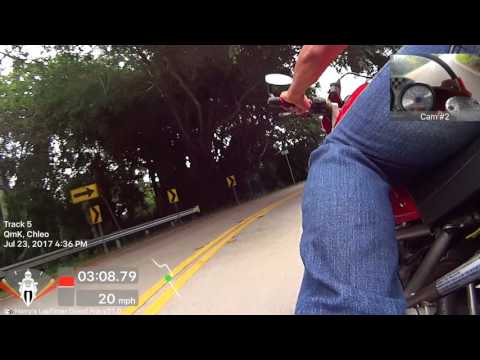
Human memory is fallible, especially under the stress of 100 MPH corners. You might think you hit every apex perfectly, but the video will often show you were three feet wide.
Pro Tip for Camera Placement: Don't just point the camera out the windshield. Mount it so the frame includes the steering wheel and your hands.
- If the video shows you "sawing" at the wheel constantly, your car is likely too "loose" (oversteer-prone).
- If you are holding a massive amount of steering angle and the car isn't turning, you have a chronic understeer issue that needs to be addressed with suspension or tire changes.
5. Portable Alignment Tools
You do not need a $50,000 alignment rack to go fast. At the track, things shift—you might clip a curbing too hard or decide you need more "turn-in" for a technical course.
- Toe Plates: These are two flat plates that rest against your tires. They allow you to measure "toe" (whether tires point toward or away from each other) using two tape measures. A small change in toe can completely transform how a car enters a corner.
- Digital Camber Gauge: A simple magnetic or rim-mounted tool ensures your wheels are tilted at the correct angle for maximum cornering grip. Being able to check this after a hard session ensures your settings haven't drifted.
6. The Weather Station
Engine performance and tire grip are heavily tied to "Density Altitude" (DA). If it is 95 degrees and humid, your car will be slower than it was at 8:00 AM in the cool, dry air.
If you don't track the weather, you might think your new suspension settings made the car slower, when in reality, the rising afternoon temperature just sapped 10 horsepower from your engine. A basic handheld weather station or a phone app that tracks DA provides the context you need for your lap times.
The Golden Rule: Change One Thing at a Time
The most important "tool" in your kit is discipline. If you change your tire pressures, your shock settings, and your rear wing all in one session, you will have no idea which change actually affected the car.
Follow this workflow:
- Run a baseline session and record data.
- Change one setting (e.g., soften the rear shocks by two clicks).
- Run another session.
- Check the lap timer and your notebook.
- Did it get faster? If yes, keep it. If no, go back to the baseline and try something else.
Summary Checklist for Your Track Kit
| Tool | Why You Need It |
|---|---|
| Notebook and Pen | To build a historical record of what works at each track. |
| Quality Pressure Gauge | Consistency in tire pressures is the foundation of grip. |
| Tire Pyrometer | Tells you if your alignment and pressures are optimized. |
| Lap Timer | The only objective way to measure success or failure. |
| Action Camera | Corrects "driver memory" and reveals handling issues. |
| Toe Plates | Allows for quick, at-track alignment checks and adjustments. |
By using these tools to build a database, you stop being a passenger in your own development. You will arrive at the track with a plan, spend less time guessing, and more time driving fast.



No Comments Yet
Be the first to comment on this article.