Curtis.Castiglione@ROzebra.com

Maintaining Serpentine Belt Systems
Have you ever started your truck on a cold morning and heard a rhythmic chirping sound coming from under the hood, almost like a bird was trapped in the engine bay? Or perhaps you have noticed a faint metallic rattling while sitting at a stoplight that seems to disappear the moment you start driving.
Most drivers dismiss these sounds as "old car noises," but in the shop, we hear them as early warning signals. If you ignore those squeals and chatters, you might find yourself stranded on the shoulder of the highway with a heavy steering wheel, a dead battery, and an overheating engine.

The Lifeblood of Your Accessories
As a technician, I see these symptoms frequently on Ford engines, ranging from the hard-working 5.0L Coyote V8s to the turbocharged EcoBoost series. To understand why these sounds matter, you have to understand the serpentine belt’s job.
This heavy-duty rubber belt transmits power from the engine’s crankshaft to all your vital accessories:
- The Alternator: Keeps your battery charged and electronics running.
- The Power Steering Pump: Provides the hydraulic pressure that makes the vehicle easy to maneuver.
- The Water Pump: Circulates coolant through the block and radiator to prevent engine meltdown.
- The A/C Compressor: Keeps the cabin cool during the summer months.
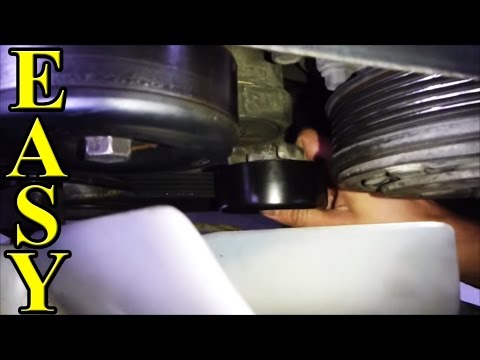
However, the belt cannot do this job alone. It relies on idler pulleys and a belt tensioner to stay in place and maintain the exact amount of pressure required to turn those heavy components.
Why the Chirping Starts: Bearing Failure
The most common culprit behind that "chirping" sound is a failing bearing in the idler pulley or the tensioner pulley. Inside these pulleys are sealed ball bearings packed with high-speed grease. Over tens of thousands of miles and countless heat cycles, that grease eventually dries out or becomes contaminated.
When the lubrication fails, the metal bearings begin to grind against their "race" (the internal track). At first, it is a high-pitched chirp. Eventually, it becomes a constant metallic roar. If a bearing seizes completely, the pulley stops turning entirely. The belt will then slide over a stationary object, creating instant friction and heat that snaps or melts the belt within seconds.

The Tensioner: A Spring Under Stress
While an idler pulley is just a wheel on a fixed bracket, the tensioner is a complex, spring-loaded arm. It is designed to apply constant, dynamic pressure to the belt even as the belt stretches or the engine changes speed. Inside that assembly is a heavy-duty coil spring and a damping mechanism.
Over time, two things happen:
- Spring Fatigue: The spring loses its strength. This leads to "pulley oscillation," where the tensioner bounces excessively while the engine is running. This vibration puts immense stress on the bearings of every other part of the system, including your expensive alternator and A/C compressor.
- Pivot Bushing Wear: If the internal bushing wears out, the tensioner arm can tilt. This causes the belt to "track" toward the edge of the pulleys. If you see your belt hanging slightly off the edge of a pulley, or see shiny metal on the sides of the pulley "fences," your tensioner is misaligned. This is the leading cause of "thrown belts," where the belt simply pops off the drive system entirely.
The Stakes: Why You Can Not Wait
The severity of this issue cannot be overstated. If your belt fails due to a worn tensioner or seized pulley, you will experience:
- Immediate Loss of Power Steering: This makes the vehicle incredibly difficult to turn, which is dangerous at low speeds or in heavy traffic.
- Charging Failure: Your battery will stop receiving power from the alternator, and the car will eventually die as the electrical system drains.
- Rapid Overheating: On many Ford engines, the water pump stops circulating coolant immediately when the belt fails. This can lead to an overheat condition in just a few minutes, potentially causing thousands of dollars in cylinder head and head gasket damage.
Technician Advice: What to Ask Your Mechanic
When you take your vehicle in for service, do not just ask for a "belt change." A common mistake is putting a brand-new, stiff belt on a tired, worn-out tensioner. The increased tension of a new belt often acts as the final straw for an aging spring or a dry bearing.
Instead, ask your mechanic for a "System Inspection." Specifically, have them check for:
- Pulley Oscillation: Is the tensioner arm jumping or vibrating excessively while the engine idles?
- Take-up Range: Most Ford tensioners have cast-in wear marks on the housing that show if the belt is stretched or if the internal spring has lost its tension.
- Alignment: Is the belt tracking perfectly straight across all pulleys, or is it rubbing against the edges?
The Best Practice: Replace the serpentine belt, the tensioner, and the idler pulleys as a complete kit. Since these parts have all covered the same mileage and endured the same heat, they usually reach the end of their service life around the same time. Addressing these symptoms early turns a potential roadside emergency into a simple piece of preventative maintenance, keeping your power steering smooth and your engine running cool.
Written by Curtis Castiglione



No Comments Yet
Be the first to comment on this article.