Curtis.Castiglione@ROzebra.com
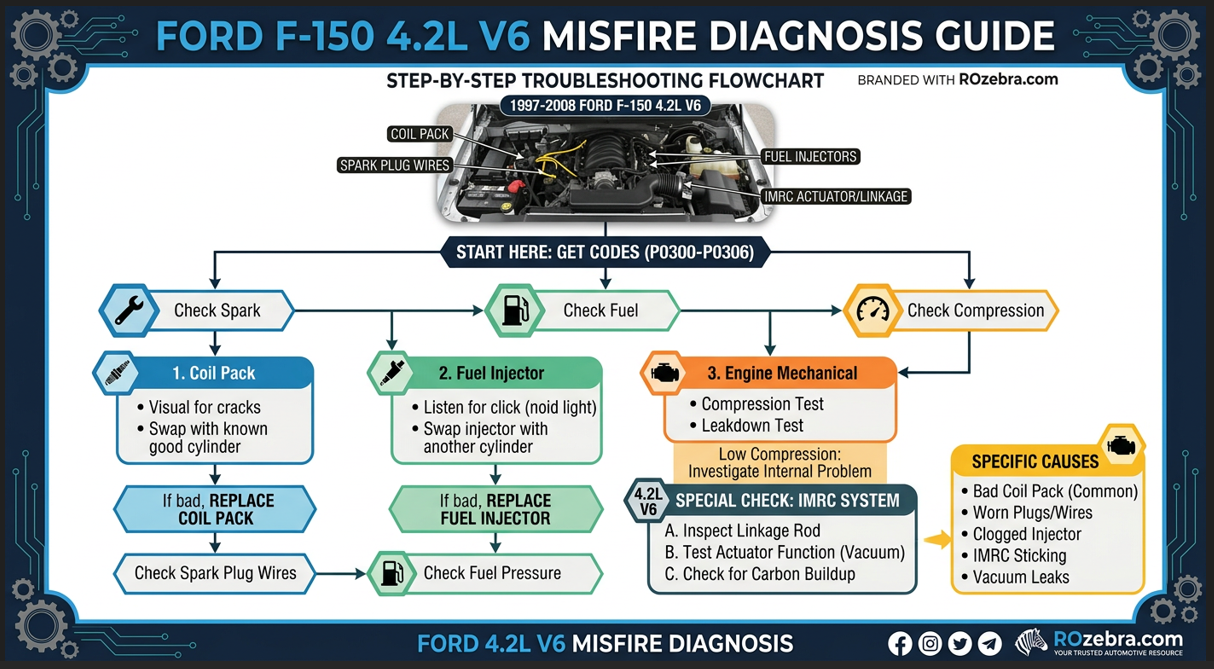
Ford F-150 4.2L V6 Misfire Diagnosis
You are sitting at a red light in your 2007 Ford F-150, and suddenly, the steering wheel starts to vibrate. The whole truck feels like it is shivering, and the idle drops just enough to make you wonder if the engine is about to stall. When the light turns green and you step on the gas, the truck stumbles and hesitates—feeling weak and heavy—before finally finding its feet and accelerating. Maybe that dreaded Check Engine light is even flashing at you.
It is a frustrating experience that makes your reliable workhorse feel unpredictable and broken. In the world of the Ford 4.2L V6, these symptoms almost always point to one common culprit: an engine misfire.
What Exactly is a Misfire?
As a technician who has spent years under the hoods of these "Essex-platform" engines, I can tell you that while the 4.2L is a remarkably durable engine, its ignition system has a few specific personality traits.
When your engine misfires, it means one or more of the six cylinders is failing to complete a proper combustion cycle. Instead of a controlled explosion that pushes the piston down, you get a "dead stroke." This sends unburned fuel into your exhaust system and creates that rhythmic shaking you feel in the driver’s seat.
The Prime Suspect: The Ignition Coil Pack
The first place we look on this specific engine is the ignition coil pack. Unlike many modern trucks that use a "coil-on-plug" design (where every spark plug has its own dedicated transformer), your 2007 4.2L uses a single, centralized coil pack located on the side of the engine.

- The Failure: Over years of heat cycles and engine vibration, the plastic housing of this coil pack can develop hairline cracks.
- The Symptom: These cracks allow electricity to "leak" out or "arc" to the engine block rather than traveling to the spark plug.
- Pro Tip: If your truck seems to buck or jerk specifically when you are traveling uphill in overdrive, a failing coil pack is almost certainly the root cause.
The Supporting Cast: Plugs and Wires
Following the trail from the coil, we find the spark plug wires and the plugs themselves. Because the 4.2L is a pushrod engine with a compact head design, the spark plugs are tucked away where they endure significant heat.
As the electrodes on the spark plugs wear down, the gap the electricity must jump becomes too wide. This forces the ignition system to work harder, which eventually breaks down the insulation in the spark plug wires. We often see "carbon tracking" on these wires—tiny scorched paths where the electricity has burned its way through the rubber to find a shorter path to ground.

The Technical Curveball: Vacuum Leaks
Sometimes, what feels exactly like an ignition misfire is actually a vacuum leak. This engine architecture is notorious for failing intake manifold gaskets and "isolator bolts."
The rubber seals on these bolts degrade over time, allowing "unmetered" air (air the computer doesn't know about) to enter the engine. This creates a lean condition, meaning there is too much air and not enough fuel for a clean burn.
- How to tell the difference: A lean misfire usually feels worse when the truck is idling at a stoplight but seems to smooth out once you are driving at highway speeds.
Action Plan: What to Discuss with Your Mechanic
If you are heading to the shop, being specific can save you money on diagnostic time. Tell your mechanic:
- When it happens: Does the shaking happen only when the engine is cold, or only under a heavy load like towing?
- The "Mode 06" Request: Ask the technician to check the "Mode 06" data on their diagnostic scanner. This allows them to see "misfire counts" for each individual cylinder, even if the computer hasn't triggered a Check Engine light yet.
- The Flashing Light Warning: If your Check Engine light starts flashing, pull over safely and stop driving immediately. A flashing light indicates a severe misfire that is dumping raw fuel into your catalytic converters. Ignoring this can turn a simple spark plug replacement into a multi-thousand-dollar exhaust repair.
The Technician's Recommendation
For a 2007 model, I generally recommend a "system-wide" approach. If one spark plug or wire has failed due to age, the others are likely right behind it. Replacing the coil pack, wires, and plugs with high-quality components is the best way to restore that smooth, factory-level idle and ensure your F-150 stays on the road for another hundred thousand miles.
Written by Curtis Castiglione



No Comments Yet
Be the first to comment on this article.