Curtis.Castiglione@ROzebra.com
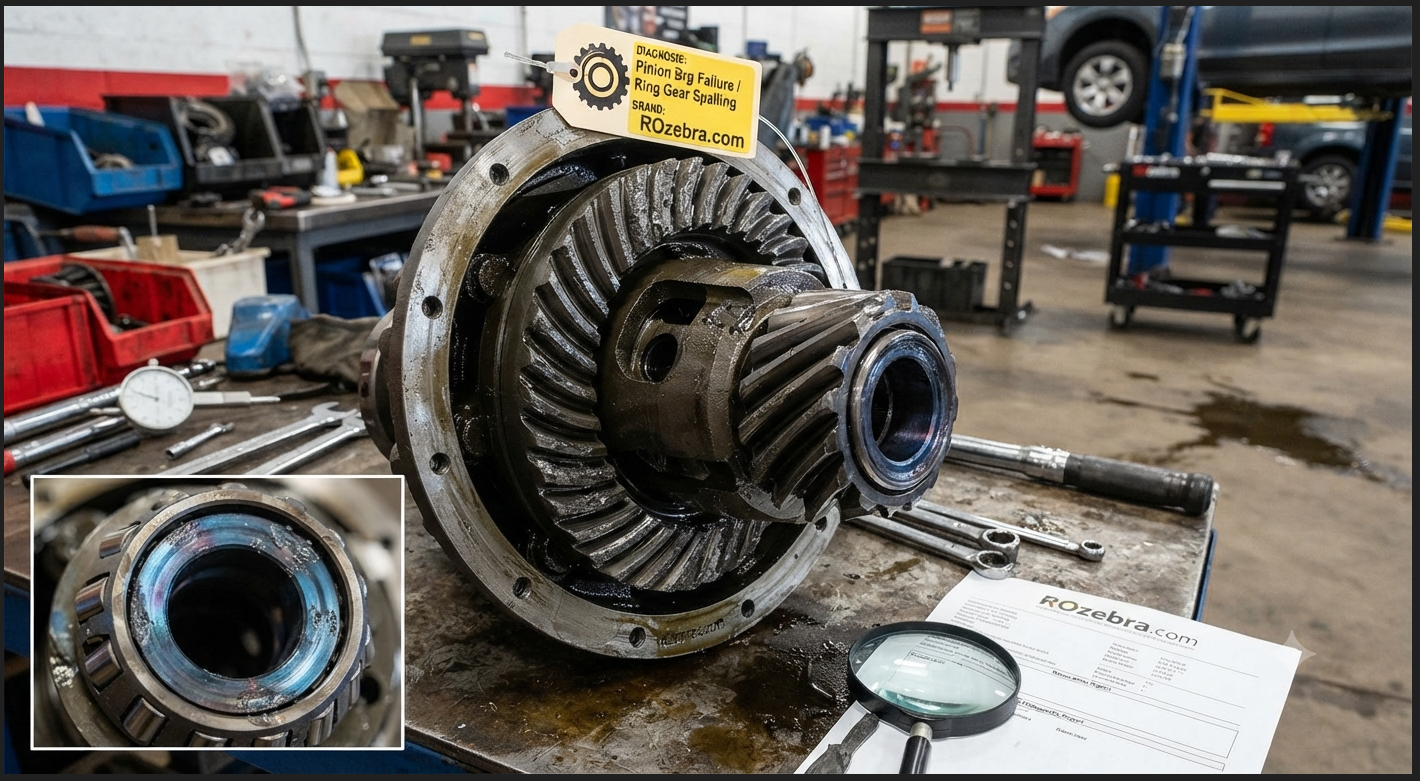
Differential Gear Wear and Pinion Bearing Diagnosis
You are cruising down the highway in your Ford truck, and as you accelerate to pass a slower vehicle, you hear it: a faint, high-pitched howl coming from somewhere beneath the bed. At first, you might think it is just wind noise or perhaps the aggressive tread on your new all-terrain tires. But then you notice that the moment you take your foot off the gas, the sound changes or disappears entirely. Maybe it evolves into a low-frequency growl or a rhythmic whirring that seems to sync up with the speed of your wheels.
For many truck owners, these sounds are the first warning signs that something is going wrong inside the differential assembly. As a technician, I can tell you that your truck is trying to tell you a story—and the sooner you listen, the less it will cost you to fix.
Listening to the Language of the Drivetrain
In the world of drivetrain diagnostics, we refer to these noises as "complaint-specific" because the timing of the noise tells us exactly which component is failing. By paying attention to when the noise occurs, you can give your mechanic a massive head start.
- Whine During Acceleration: If you hear a high-pitched whine specifically when you press the gas, you are likely dealing with a pinion bearing that has lost its preload or a ring and pinion gear set that is no longer meshing correctly.
- Whine During Coasting: If the noise occurs only when you let off the throttle, it usually points toward a failing outer pinion bearing.
- Constant Low Growl: A steady, low-pitched rumble that gets louder as your wheel speed increases—regardless of acceleration—often indicates that the carrier bearings are the culprits.

The Technical Reality: Why the "Howl" Happens
To understand why these noises happen, you have to look at the mechanical relationship between the pinion gear and the ring gear. The pinion is the small gear at the end of your driveshaft that turns the much larger ring gear attached to your axle shafts.
In a healthy Ford 8.8 or 9.75-inch rear end, these components must meet with incredible precision. We measure this in backlash, which is the tiny amount of clearance between the teeth of the gears. This clearance is usually only about eight to twelve thousandths of an inch—roughly the thickness of three sheets of paper.
When a pinion bearing begins to wear down, it allows the pinion gear to move out of its fixed position. This movement alters the backlash, causing the gear teeth to scuff rather than roll smoothly against each other. That high-pitched whining you hear in the cabin is the sound of metal-on-metal friction resulting from a compromised gear geometry.
What Happens in the Shop: The Diagnostic "Crime Scene"
When you bring your truck into the shop, the first thing we do is pull the differential cover to inspect the oil. This is a crime scene for a technician. Healthy gear oil should be dark but translucent.

If the oil looks like metallic silver paint, or if there are actual metal chunks stuck to the magnetic drain plug, it indicates spalling. This is a process where the hardened surface of the bearings or gear teeth starts to flake off due to heat and pressure. Once spalling starts, the damage is irreversible.
To confirm the extent of the wear, we perform a gear pattern test:
- We apply a bright yellow or white marking compound to the ring gear teeth.
- We rotate the assembly to see where the gears are making contact.
- A healthy pattern is a centered, oval-shaped mark.
- A failing pattern is pushed too high toward the "face" or too low toward the "flank" of the tooth, confirming that the bearings have failed and the geometry is shot.
Actionable Advice: Don’t Wait for the Vibration
A whining differential is a cry for help. If you catch it early, a technician can often perform what we call a "re-bearing." This involves replacing only the worn bearings and seals while keeping your original gear set, which can save you a significant amount of money in parts.
However, if you ignore the howl until it becomes a heavy vibration, the heat generated by the failing bearings will eventually warp the ring and pinion gears themselves. At that point, you are looking at a full rebuild or a complete differential replacement.

What to tell your mechanic:
When you drop off your truck, do not just say "there is a noise." Be specific about the symptoms to help the diagnostic process:
- "I hear a high-pitched whine at 60 MPH only when I am on the gas."
- "The noise goes away completely when I am coasting."
- "There is a rhythmic growl that changes with tire speed, regardless of my engine RPM."
Addressing these mechanical indicators early is the best way to ensure your drivetrain remains reliable and prevents a minor bearing hum from turning into a major roadside breakdown.
Written by Curtis Castiglione



No Comments Yet
Be the first to comment on this article.