Curtis.Castiglione@ROzebra.com
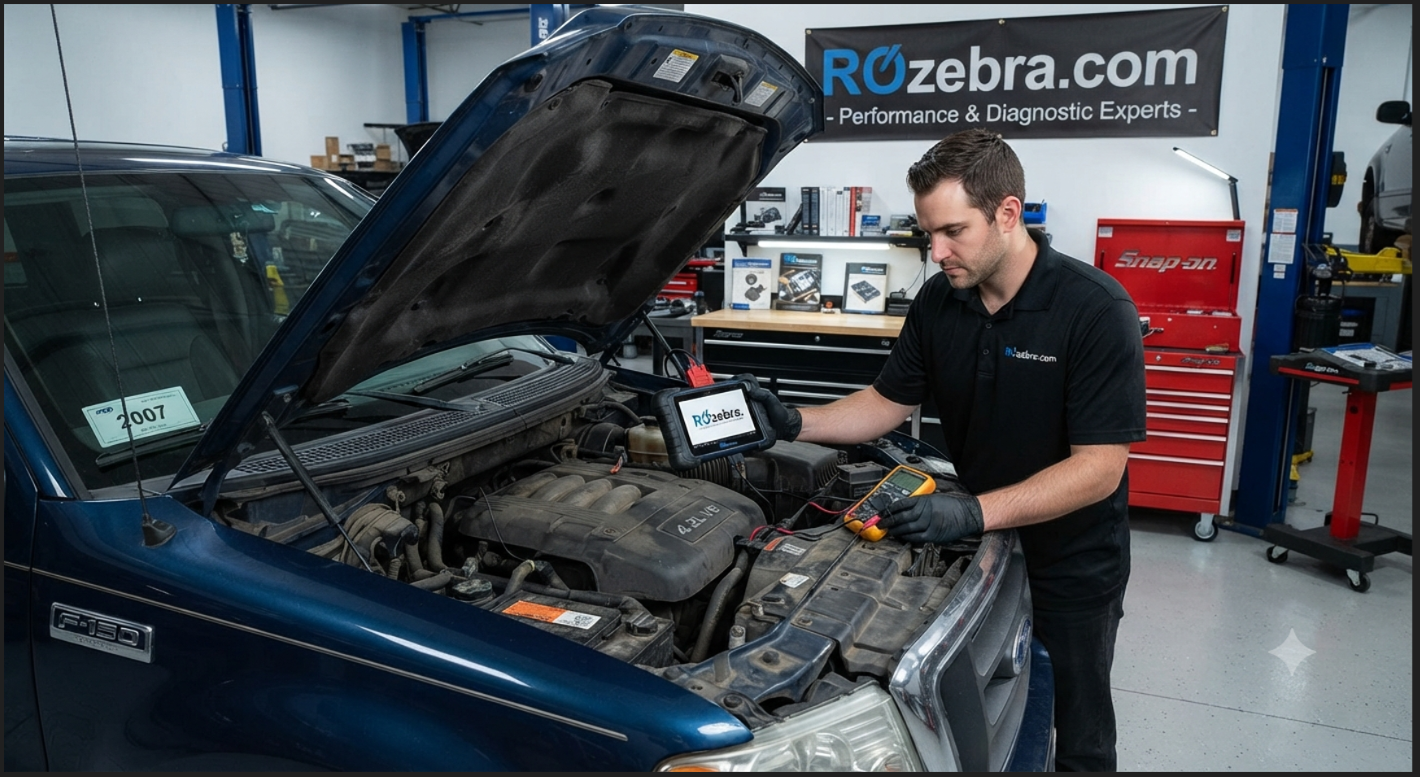
Diagnosing 2007 Ford F-150 4.2L V6 Idle Hesitation
You are sitting at a red light, your foot is firmly on the brake, and suddenly the steering wheel starts to vibrate. The engine rhythm feels uneven, like it is gasping for air or skipping a beat. You might describe it as a stumble, a hiccup, or a shivering sensation that makes you wonder if the truck is about to stall right there in the middle of traffic.
When you finally get the green light and press the gas, the hesitation often vanishes as you pick up speed, only to return the moment you slow down to a crawl. It is an unsettling feeling that makes an otherwise reliable workhorse feel untrustworthy.
As a technician who has spent years under the hoods of these eleventh-generation F-Series trucks, I can tell you that while your first instinct might be to go out and buy a new set of spark plugs, the 4.2L V6 engine has a very specific set of quirks. This hesitation at idle is rarely just a tune-up issue; it is usually a sign that the engine’s delicate balance of air, fuel, and spark has been disrupted by a mechanical failure or a sensor sending bad data to the computer.
The Technical Culprits: Why Your V6 is Struggling
The 4.2L V6 is a different beast than its V8 brothers. To diagnose it properly, we have to look at the three most common points of failure that cause that annoying idle stumble.
1. The Unmetered Air Problem (IMRC and Vacuum Leaks)
One of the most common offenders on the 2007 4.2L is a vacuum leak. Specifically, this engine uses an Intake Manifold Runner Control (IMRC) system. This setup relies on plastic bushings and rubber seals to control airflow into the cylinders.
Over time, engine heat makes these plastic components brittle until they snap. When a bushing breaks, it can leave an open hole where unmetered air enters the engine. Because the Mass Airflow (MAF) sensor did not see this air coming, the computer does not add enough fuel to compensate. This creates a lean condition, which manifests as that annoying stumble when the engine is under the least amount of load—at idle.
2. The Dirty Messenger (The MAF Sensor)
The MAF sensor is a tiny, delicate wire that sits in your intake stream. Its job is to tell the computer exactly how much air is entering. In an older truck, dust or oil film can coat this sensor. If it is dirty, it sends lazy data. At high speeds, the error might be negligible, but at idle, even a small miscalculation leads to a weak combustion cycle and a shivering engine.
3. The Spark Jump (Coil Pack and Wires)
Unlike the V8 F-150s, which use a coil-on-plug system, your 4.2L V6 uses a single ignition coil pack with traditional spark plug wires. These wires live in a high-heat environment and can develop micro-cracks. At idle, the electrical resistance is different than at cruising speeds, and a weak spark can actually jump from a cracked wire to the engine block instead of reaching the plug. This results in a rhythmic misfire that feels like a constant shudder.
How a Professional Tech Diagnoses the Shiver
When you bring your truck in, we do not just start throwing parts at it. We follow a specific diagnostic path to ensure we are fixing the actual root cause:
- Scanning Fuel Trims: We look at the Short Term and Long Term fuel trims. If the numbers are high at idle but return to normal when we rev the engine, that is a smoking gun for a vacuum leak.
- Reading the Codes: We look for specific trouble codes like P0171 or P0174 (indicating the engine is running lean) or P0300 (a random misfire).
- The Smoke Test: We often use a smoke machine to pressurize the intake system. Seeing smoke waft out from behind the manifold usually points directly to those broken IMRC bushings or a collapsed PCV hose.

Why You Should Not Ignore the Hesitation
It is tempting to just live with a rough idle, but ignoring it can lead to a massive repair bill. When an engine misfires or runs lean, unburned fuel can exit the combustion chamber and enter your exhaust. This fuel eventually superheats and melts the internal honeycomb structure of your catalytic converters. What could have been a simple vacuum line repair or a sensor cleaning can quickly turn into a four-figure exhaust overhaul.
Actionable Advice for the Owner
If your F-150 is shivering at stoplights, it is likely a clear signal that the engine is fighting an air leak or a weak spark. When you talk to your mechanic, be sure to mention:
- If the hesitation happens more when the engine is cold or hot.
- If the Check Engine light is flashing (which indicates an active, damaging misfire).
- If the problem disappears completely once you are at highway speeds.
Providing these details will help your technician pinpoint the issue quickly, getting your V6 back to its smooth, reliable self without wasting money on parts you do not actually need.
Written by Curtis Castiglione
Take the Quiz for this Article Here!



No Comments Yet
Be the first to comment on this article.