Curtis.Castiglione@ROzebra.com
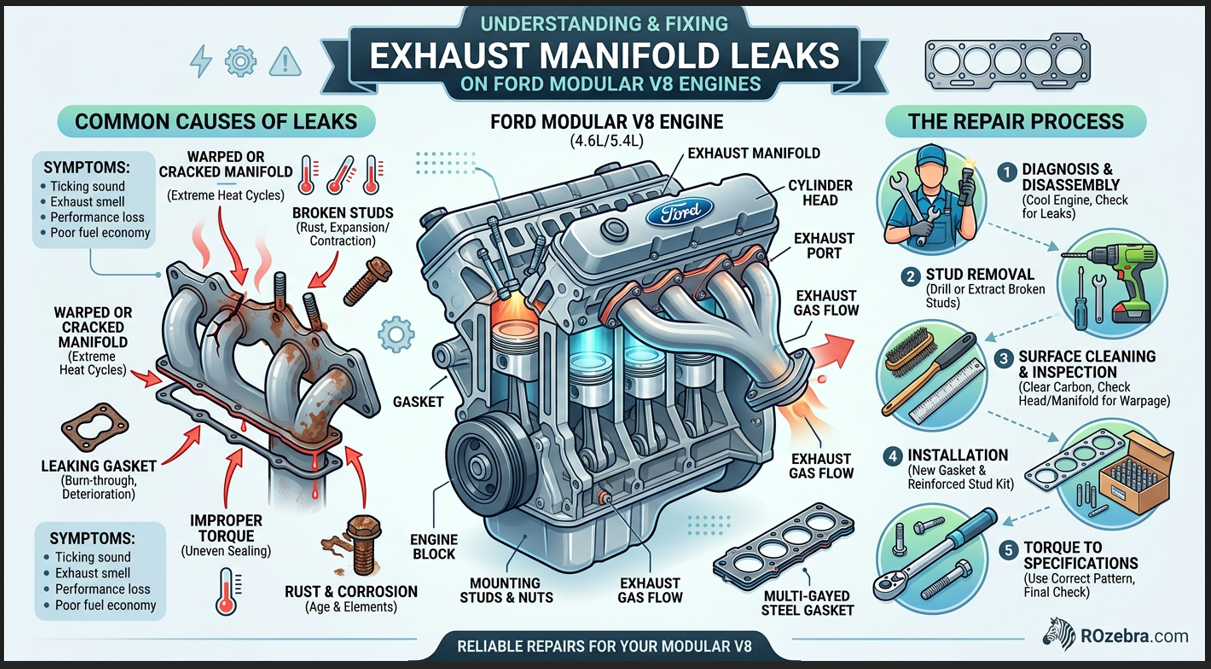
Causes and Cures for Ford Modular Engine Exhaust Manifold Leaks
Have you ever stepped out to your driveway on a cold morning, turned the key in your F-150 or Expedition, and been greeted by a sharp, rhythmic ticking sound? It sounds almost like a metallic woodpecker is trapped under your hood, tapping away at the engine block.
Naturally, you might feel a pit in your stomach. Is it a bad lifter? A collapsed valve? Is the engine about to give up? But then, something strange happens: as the engine warms up over the next five or ten minutes, that annoying tick mysteriously fades away, replaced by the normal, quiet hum of the road. While it might feel like the problem fixed itself, you have actually just heard the signature of a classic Ford modular engine issue.

The Root Cause: A Thermal Tug-of-War
As a technician, I see this issue constantly on Ford 4.6L, 5.4L, and 6.8L V10 engines. To understand why your truck is tapping, we have to look at the physics of the engine.
Your engine block and cylinder heads are made of aluminum, while the exhaust manifolds are typically heavy cast iron. These two metals have very different thermal expansion rates. When you start your truck, the exhaust gases—which are hundreds of degrees—instantly heat the manifold. The iron expands and "walks" across the surface of the aluminum head.
The steel studs holding the manifold in place are caught in the middle of this constant movement. Over thousands of heat cycles, the shearing stress, combined with inevitable rust and corrosion, eventually snaps the studs. Usually, the studs at the very back of the engine (cylinders four and eight) break first because they endure the most movement.
Why does the noise go away? When the engine is cold, the broken stud allows a tiny gap to form between the manifold and the head. The tick you hear is high-pressure exhaust gas escaping. Once the manifold heats up enough, the metal expands and physically closes that gap, temporarily sealing the leak.
Why You Should Not "Just Live With It"
It is tempting to ignore a noise that disappears after five minutes, but leaving this unaddressed can lead to expensive consequences:
- Poor Fuel Economy: An exhaust leak upstream of the oxygen (O2) sensors allows "fresh" air to be sucked into the exhaust stream. The sensors detect this extra oxygen and trick the computer into thinking the engine is running "lean." To compensate, the computer dumps extra fuel into the cylinders, tanking your MPG.
- Catalytic Converter Damage: That extra fuel does not all burn; some of it ends up in your catalytic converters, which can lead to overheating and premature failure—a very expensive part to replace.
- Cylinder Head Erosion: Escaping hot gases act like a miniature torch. Over time, they can erode the flat mounting surface of your aluminum cylinder head. If this happens, a simple bolt replacement turns into a massive bill for head machining.
The Technician’s Solution: Extraction and Upgrades
When you bring your truck to the shop, do not be surprised if the quote seems high. These studs often break off flush with or even inside the cylinder head, making them impossible to grab with pliers.

We typically use two professional methods for extraction:
- The Welding Method: We use a MIG welder to build a small nub of metal onto the broken stud, then weld a nut to that nub. The intense, localized heat from the welder helps break the bond of the rust, allowing us to back the stud out safely.
- Precision Templates: In tight spaces where we cannot weld, we use specialized drilling jigs that bolt onto the head. These ensure the drill bit stays perfectly centered so we do not damage the soft aluminum threads.
Upgrading for the Future
If you plan on keeping your Ford for several more years, I always recommend upgrading the hardware rather than using factory replacements.
- Stainless Steel Stud Kits: These resist corrosion much better than the original steel.
- Grade 8 Bolts: Higher strength ratings can better handle the shearing forces.
- Aftermarket Headers: Some owners choose to replace the heavy cast iron manifolds with tubular headers, which are more flexible and put significantly less stress on the mounting hardware.
Summary for the Owner
If your truck is ticking in the morning, it is time for a conversation with your mechanic. When you call, ask specifically: "Do you have experience extracting broken manifold studs on Ford modular engines?" and "Can we upgrade to stainless steel hardware to prevent this from happening again?"
Addressing the "woodpecker" under your hood early will protect your cylinder heads, save your fuel budget, and ensure your Ford stays quiet and efficient for the long haul.
Written by Curtis Castiglione



No Comments Yet
Be the first to comment on this article.