Curtis.Castiglione@ROzebra.com

Alternator Charging System Diagnostics
Imagine you are heading out for work, already a few minutes behind schedule. You hop in, turn the key, and instead of the usual roar of the engine, you get a sluggish, tired groan. Or worse—a rapid-fire clicking sound that tells you that you are not going anywhere.
Maybe you have noticed that your headlights seem to dim every time you come to a stoplight, or perhaps there is a strange, high-pitched whining sound coming from under the hood that gets louder as you accelerate. While most drivers immediately point the finger at a dead battery, as a technician, I often find the real culprit is the battery's partner in crime: the alternator.
The Alternator: Your Vehicle’s Power Plant
Think of the battery as a storage tank that gets the engine started. Once the car is moving, the alternator takes over as the powerhouse. It performs a vital task: converting mechanical energy from the engine’s rotating crankshaft into electrical energy. This keeps your lights on, your radio playing, and your battery charged.

This process happens via the serpentine belt, which spins a rotor inside a nest of copper windings known as a stator. This movement creates an electromagnetic field that generates alternating current (AC).
The Hidden Translators: Diodes and Regulators
Your car’s sensitive electronics and battery cannot run on AC power; they require direct current (DC). This is where the internal components of the alternator become critical:
- The Diode Bridge: Think of the diode bridge as a one-way electrical gate that converts AC into DC. When one or more of these diodes fail, it leads to a phenomenon we call AC ripple. This is essentially dirty electricity leaking into your car’s system. It can cause your radio to hum, your dashboard lights to flicker, or even cause your car’s computer to behave erratically. If ignored, AC ripple can eventually cook your battery or fry expensive control modules.
- The Voltage Regulator: This component acts as a sentry, ensuring the electrical output stays within a specific range, usually between 13.8 and 14.4 volts. If the regulator fails high, it might allow the alternator to overcharge the battery, literally boiling the acid inside and ruining it. Conversely, if it undercharges, your battery will slowly drain until the car dies in the middle of traffic because it simply cannot keep up with the vehicle's electrical demands.
How We Diagnose the Heartbeat
When you bring your vehicle to the shop with these symptoms, we do not just guess. We perform what is known as a load test to see how the system handles pressure.
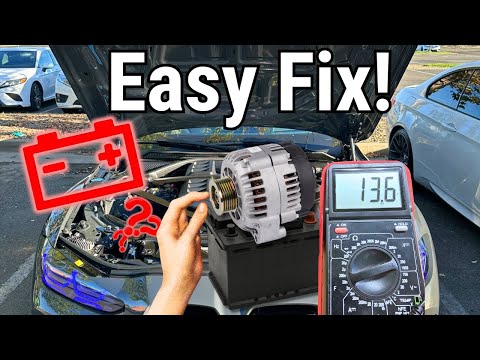
First, we check the resting voltage of the battery with a multimeter. Then, we perform the stress test. We start the engine and turn on every electrical load possible—the high beams, the air conditioning on max, the rear defroster, and the heated seats. A healthy alternator should be able to maintain its output even under this heavy demand.
For more complex issues, we use an automotive oscilloscope. This tool allows us to see a visual representation of the electrical wave the alternator is producing.

If that wave looks jagged or inconsistent on the screen, we know the diode bridge is failing, even if a basic multimeter says the voltage is within a normal range.
Red Flags: When to See Your Mechanic
You should have your charging system inspected immediately if you notice any of these warning signs:
- The battery symbol (red icon) stays illuminated on your dashboard.
- A smell like burning rubber or ozone (an electrical fire smell) coming from the engine bay.
- Ghost symptoms, like power windows moving slowly or a radio that cuts out unexpectedly.
- Whining or grinding noises that change in pitch as you rev the engine.
What to Tell Your Mechanic
To help us narrow down the issue quickly, pay attention to when the symptoms occur. When you drop off your vehicle, mention if the lights flicker specifically when you use the rear defroster or if the whining sound gets louder as you speed up. Providing these details helps us distinguish between a simple belt slip, a regulator malfunction, or a diode failure.
A failing alternator is a ticking clock. It will eventually leave you stranded, and it often takes a perfectly good battery down with it. Catching these issues early will help you avoid a breakdown and prevent a small electrical gremlin from turning into a major repair bill. If your car is crying for help, do not ignore the signs!
Written by Curtis Castiglione



No Comments Yet
Be the first to comment on this article.