Curtis.Castiglione@ROzebra.com

Advanced Tire Treadwear and Structural Degradation Mechanics
UTQG treadwear grading quantifies relative longevity through a comparative ratio against a Course Monitoring Tire (CMT) over 7,200 miles. Structural degradation is governed by molecular shear and hysteresis—the dissipation of energy as heat during cyclic loading—which precipitates carcass fatigue and ultimate material mass loss at the contact patch.
1. The UTQG Framework and Indexing Limitations
The Uniform Tire Quality Grading (UTQG) index provides an empirical baseline for tire durability under controlled environmental parameters. A tire graded at 600 is mathematically projected to endure six times the mileage of the CMT on a standardized course. However, these numerical indices are performance indicators rather than absolute service life guarantees.
The index fails to account for Radial Force Variation (RFV)—the fluctuation in vertical force exerted by the tire against the road surface during rotation—or Carcass Fatigue, which is the progressive degradation of internal structural components, such as steel belts and polyester plies, due to continuous cyclic loading. Consequently, a high treadwear rating does not mitigate the risk of internal structural failure if the tire is subjected to extreme mechanical stressors or improper maintenance.
2. Mechanical Wear Vectors and Geometric Influences
Tread topography is directly influenced by the vehicle’s suspension geometry and inflation pressures. Deviations from specification initiate localized wear patterns that compromise the contact patch efficiency and reduce the grip coefficient.
Table 1: Influence of Geometry and Inflation on Tread Degradation
| Parameter Visual Wear Pattern Mechanical Cause | ||
| Excessive Toe-In | Feathered Edges | Lateral scrubbing across the tread face |
| Negative Camber | Inner Shoulder Wear | Localized loading on the inboard contact patch |
| Under-Inflation | Dual Shoulder Wear | Increased sidewall deflection and heat buildup |
| Over-Inflation | Center Rib Wear | Crown expansion reducing the effective contact patch |
| High RFV | Localized Flat Spots | Non-uniform stiffening causing erratic road contact |

3. Micro-Deformation: Molecular Shear and Abrasion
The physical reduction of tread depth is primarily a result of Molecular Shear, the mechanical disruption of polymer chains at the interface of the tire and the road. During cornering or heavy longitudinal acceleration, the slip angle creates friction that eventually exceeds the polymer’s cohesive strength, resulting in the shedding of rubber particles.
Simultaneously, the tire undergoes Hysteresis, defined as the energy dissipated as heat during the deformation cycle of the rubber compound. Excessive hysteresis leads to thermal runaway, significantly weakening the bond between the tread compound and the internal carcass.
4. Chemical vs. Mechanical Degradation
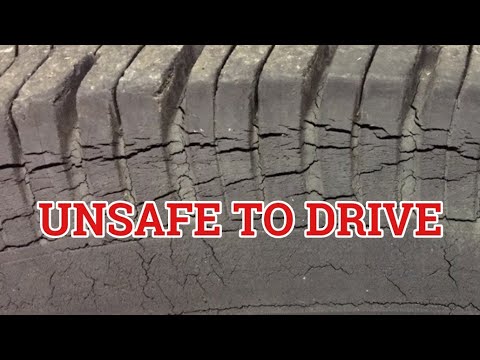
While mechanical abrasion reduces tread depth, chemical oxidation can render a tire unsafe regardless of its remaining thickness. Viscoelasticity—the property of the rubber to exhibit both viscous and elastic characteristics during deformation—is lost as the compound undergoes oxidation and hardening, commonly referred to as "dry rot."
Table 2: Comparison of Mechanical Abrasion versus Chemical Degradation
| Degradation Type Primary Mechanism Structural Impact | ||
| Mechanical | Molecular Shear | Reduced tread depth and hydroplaning resistance |
| Thermal/Ozone | Oxidation/Hardening | Loss of viscoelasticity and grip coefficient |
| Cyclic Loading | Carcass Fatigue | Internal ply separation and potential blowout |
| Dynamic Stress | Hysteresis | Polymer chain scission and thermal runaway |
5. Diagnostic Analysis of Premature Wear
For the automotive engineer, identifying the root cause of premature wear is essential for maintaining vehicular structural integrity. Visual cues in the tread often indicate systemic failures in the chassis, damping systems, or maintenance protocols.
Table 3: Primary Causes of Premature Treadwear and Visual Characteristics
| Cause Visual Pattern Structural Implication | ||
| Misalignment | Feathering or Sawtooth | Uneven lateral force distribution |
| Improper PSI | Shoulder or Center Wear | Excessive hysteresis or crown tension |
| Suspension Wear | Cupping or Scalloping | Erratic damping causing inconsistent contact |
| Unbalanced Mass | Patchy Wear | Non-uniform centrifugal force distribution |
Conclusion
Treadwear must be interpreted as a multidimensional derivative of chemical stability and mechanical stress. While UTQG provides a standardized benchmark, real-world longevity is dictated by the management of heat, pressure, and alignment geometry. Practitioners must prioritize the inspection of structural markers—specifically looking for evidence of carcass fatigue and the loss of viscoelasticity—to ensure the tire remains a viable component of the vehicle safety system. Engineers should focus on minimizing RFV and managing thermal loads to prevent premature structural failure.
Written by Curtis Castiglione



No Comments Yet
Be the first to comment on this article.